
Customizable Evaluation Frameworks – One Size No Longer Fits All

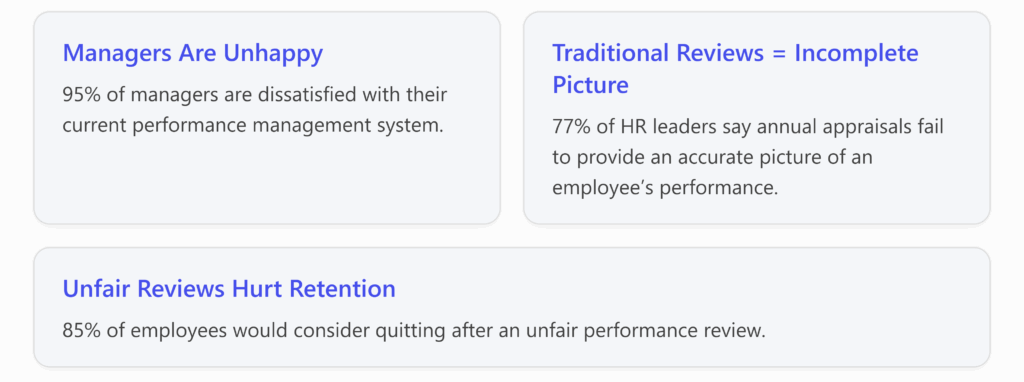
In today’s diverse workplace, a one-size-fits-all performance review is quickly becoming a relic of the past. Modern organizations demand flexibility in how they evaluate performance, and HR professionals are leading the charge toward more customizable evaluation frameworks. Rigid, cookie-cutter appraisal forms that treat every employee the same – regardless of role or company culture – just don’t cut it anymore. This shift isn’t just a fad; it’s a response to real pain points and a rapidly changing work environment. In fact, research shows that 95% of managers are unhappy with their current performance management system, and 90% of HR leaders feel traditional reviews fail to accurately reflect employee contributions[1]. It’s no wonder HR forums are full of frustration about inflexible appraisal processes. The message is clear: the era of generic, one-size-fits-all performance reviews is ending, and a new era of highly customizable evaluations is rising in its place.
Why One-Size-Fits-All Reviews Fall Short (The Problem)
Picture a company using the exact same evaluation form for every employee – whether they’re a software engineer, a nurse, or a sales representative. It’s easy to see the issue: important nuances get lost. A generic appraisal might ask a nurse about meeting quarterly sales targets, or a tech developer about patient care skills. When performance criteria aren’t relevant to an employee’s actual job, the review process loses credibility and value. Unfortunately, this scenario has been common in the past. These one-size-fits-all reviews are rigid, often full of questions or rating criteria that simply don’t apply to certain roles. Employees and managers end up going through the motions, checking boxes that don’t really measure what that employee contributes.
This lack of relevance has real consequences. Employees find the process disengaging or even demoralizing when they’re judged by metrics that don’t fit their work. Nearly three-quarters of workers say traditional performance appraisals aren’t useful[2], and 77% of HR leaders agree the old review format doesn’t give an accurate view of performance[2]. In other words, traditional appraisals often fail at their core purpose: providing fair, meaningful feedback. Even worse, a bad or “unfair” review can damage morale – 85% of employees say they would seriously consider quitting if they received an unfair performance evaluation[2]. Clearly, the stakes are high. A cookie-cutter approach isn’t just an inconvenience; it can lead to lost trust, lower engagement, and higher turnover.
HR professionals have long been aware of these issues. On HR discussion forums and networks, a common pain point is exactly this: “Our appraisal form is too generic. It doesn’t account for different roles or our unique company values.” As organizations grew more complex – with diverse job families, remote teams, and evolving business goals – the one-size-fits-all review became increasingly out of touch. It’s no surprise that almost half of organizations (46%) reported modifying their performance management approach in just the past year[2]. The pressure to change has been building for a while, and by 2025 it has reached a tipping point.
The Shift to Flexible, Customizable Evaluations (Why It’s Relevant in 2025)
Modern workplaces in 2025 demand flexibility in performance management. Companies are realizing that performance management is not a “one-size” exercise – it needs to adapt to different roles, departments, and industries. In fact, recent research validates this reality: 78% of organizations have developed customized performance management systems to address industry- or role-specific requirements[1]. That’s an astonishing majority of companies acknowledging that standardized, inflexible evaluations just don’t meet their needs.
So why now? Several trends have converged to make customizable frameworks not just nice-to-have, but necessary:
- Workforce Diversity & Specialization: Job roles are more specialized than ever, even within the same company. What success looks like for a data scientist is very different from what it looks like for a sales manager. A single generic form can’t capture both effectively. HR leaders in 2025 are tasked with supporting a wide array of talent, from creative designers to field technicians, each requiring different metrics.
- Rapid Business Change: Goals and success factors evolve quickly. Companies pivot strategies, adopt new technologies, and operate in fast-changing markets. If your performance review criteria can’t be easily updated or tailored, they become obsolete. A flexible system lets HR tweak competencies and goals as the business strategy shifts.
- Employee Expectations: Today’s employees expect personalization. From consumer experiences to workplace tools, people are used to things being tailored to them. Performance reviews are no different. Especially for younger professionals, a generic, impersonal review process can feel alienating. They crave feedback that is specific to their work and growth. Providing that means customizing the evaluation framework.
- Data and Insight: Organizations now have more data on performance drivers. They know, for example, that certain competencies correlate with success in one job but not another. Modern performance management software and analytics allow HR to identify what really matters for each role – and thus design different evaluation criteria accordingly. A one-size system can’t leverage these insights, but a customizable one can.
Let’s take a quick look at how performance management has evolved towards customization over the past decade:
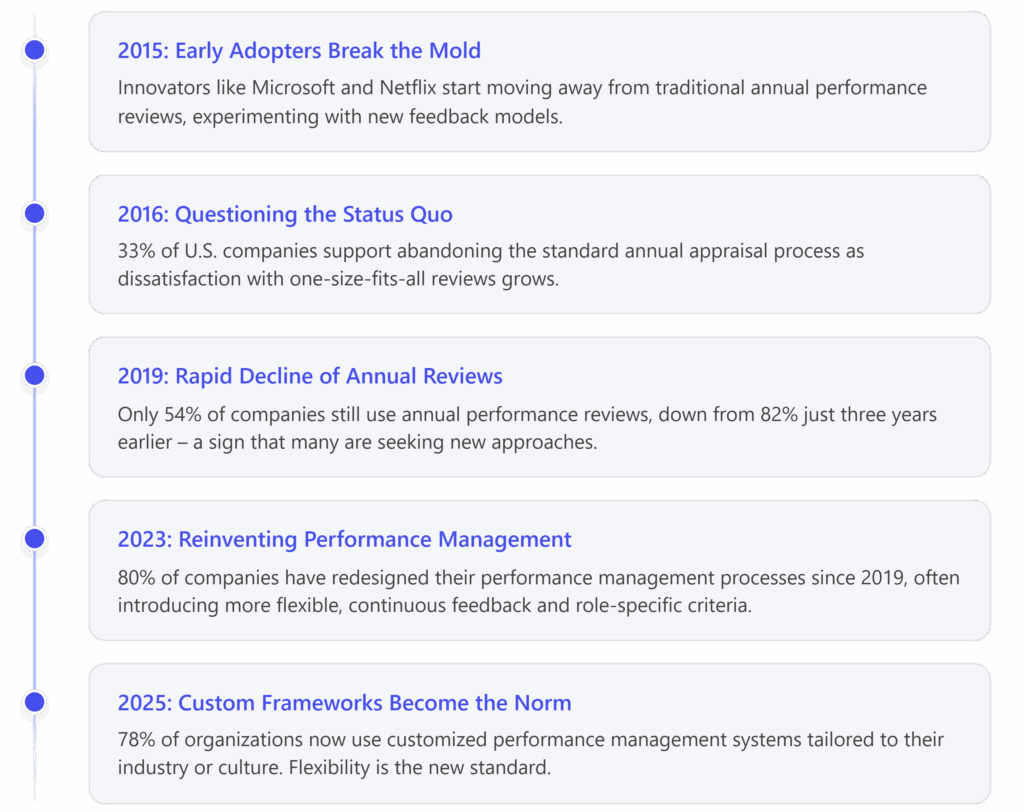
As this timeline shows, by 2025, the momentum has fully shifted. The question is no longer “Should we customize our performance evaluations?” but rather “How can we customize them effectively and efficiently?”. Companies large and small have begun overhauling their old performance review templates in favor of flexible frameworks that they can mold to fit different contexts.
What Does a Customizable Evaluation Framework Look Like?
Moving to a customizable framework means rethinking the performance review format. Instead of a single static form, HR can develop a menu of competencies, questions, and rating scales to use as needed. Here are a few key elements that organizations are now tailoring to fit their needs:
- Competencies & Skills: Rather than using a generic set of competencies for everyone, companies allow each role or job family to have its own relevant competencies. For example, a customer service role might be evaluated on communication and customer satisfaction, while a product development role focuses on innovation and technical skill. HR can choose which competencies apply to which roles, ensuring each employee is measured against the skills that matter most for their job. This makes evaluations more fair and meaningful.
- Goals & Objectives: The content of performance goals is being customized too. Modern systems let you set team-specific or role-specific goals in the evaluation form. A marketing team might have a goal around campaign reach, whereas an engineering team has goals around system uptime or feature delivery. In a customizable framework, the review form for each team will highlight their unique objectives.
- Rating Scales & Formats: One of the often overlooked aspects is the rating scale itself. Traditional reviews usually used a five-point numeric scale for everyone. But not every competency is best rated numerically, and not every company likes numeric scoring. With customization, HR can decide: perhaps use a qualitative scale (e.g., “Needs Improvement / Meets Expectations / Exceeds Expectations”) for soft skills, or stick with numeric ratings for quantitative goals. Some organizations even tailor the scale labels to fit their culture (imagine a company that uses “Rockstar” or “Trailblazer” as top ratings to fit a theme). The point is, the format can fit the culture – no more forcing everything into one mold.
- Questions & Sections: In flexible evaluation design, HR can add or remove sections of the appraisal form. You might include a section on Leadership & People Management only for people managers, and omit it for individual contributors. You might have a set of questions about Cultural Values alignment for all employees, but additional role-specific questions for certain departments. For instance, add a section for Safety Practices in a factory or healthcare setting, which wouldn’t appear in an office role’s review. Each template is composed of the sections that make sense for that group of employees.
- Frequency & Workflow: While not exactly a “framework” component, it’s worth noting that flexibility extends to the review cycle as well. Many organizations now tailor how often they conduct reviews or check-ins based on the role or department needs. A sales team might do quarterly check-ins due to fast-paced targets, whereas another team might stick to semi-annual reviews. Customizable systems often accommodate multiple workflows (continuous feedback, annual reviews, project-based reviews, etc.) under one umbrella.
By customizing these elements, companies ensure that performance evaluations truly reflect each employee’s contributions and development areas. When an employee sits down for their review, they’re more likely to feel that the process “gets” what they do. Managers, too, find it easier to evaluate apples-to-apples – because the form in front of them was designed for the role they’re reviewing, not a generic average role.
One Size No Longer Fits All: Examples Across Industries
Another reason customizable evaluations have taken off is that different industries – and even different teams – have wildly different definitions of success. A metric or question that is critical in one context might be irrelevant (or even ridiculous) in another. Let’s explore a few scenarios:
- Tech Startups: Imagine a fast-moving software startup. It likely emphasizes innovation, collaboration, and speed. A performance review here might include criteria like “contributes creative solutions,” “demonstrates teamwork in agile sprints,” and “learning new technologies.” Traditional reviews that focus on static metrics or long-term goals wouldn’t capture these well. Instead, a customizable approach lets the startup weight things like innovation and teamwork heavily. This ensures employees are evaluated on how much they contribute to new ideas and collaborative projects – exactly what a tech startup cares about.
- Sales-Driven Companies: In a sales-oriented organization, everything revolves around the pipeline and client satisfaction. A generic appraisal form might not emphasize these enough. But in a custom framework, the sales team’s review template can be packed with sales-specific criteria: meeting quotas, quality of client relationships, upselling skills, customer feedback scores, etc. For example, a salesperson’s performance might be 50% based on hitting revenue targets and 30% on client satisfaction ratings. Meanwhile, those metrics wouldn’t appear at all on an engineer’s review form – and they shouldn’t. Customizing by job family makes the evaluation relevant. As a result, sales employees feel properly recognized for their core work (and accountable for the right targets), rather than wading through irrelevant questions about things like coding or design.
- Healthcare Organizations: In healthcare, roles like doctors, nurses, or technicians have critical competencies around patient care, accuracy, and compliance. A hospital will want to evaluate how well a nurse adheres to safety protocols, bedside manner, teamwork in a unit, and patient outcomes. They might use a custom evaluation section for “Patient Care & Safety” and another for “Clinical Knowledge & Skills.” A one-size-fits-all corporate appraisal form would completely miss these nuances. Perhaps that’s why 85% of healthcare organizations have adopted real-time competency tracking tailored to clinical roles[1] – it’s an industry where specific skills literally impact lives. Custom frameworks allow healthcare employers to ensure each clinician is reviewed against the standards that align with delivering excellent patient care.
- Retail & Customer Service: Retail companies and customer service teams often focus on efficiency, customer satisfaction, and teamwork. For a retail store associate, metrics like “monthly sales per employee,” “customer satisfaction survey results,” and “attendance/reliability” might be key. Retailers might customize their performance reviews to track things like upselling rates, inventory management accuracy, or speed at checkout, depending on the role. In contrast, these metrics don’t apply to, say, an accountant at corporate HQ. By tailoring the framework, retail organizations align evaluations with the factors that drive store success. This has tangible benefits – retail teams that implemented data-driven, role-specific performance metrics saw 30% higher employee productivity and a 25% boost in customer satisfaction[1]. It’s a great example of how aligning the review criteria with what really matters (sales per square foot, customer feedback, etc.) can improve outcomes.
- Creative Industries: Let’s also consider fields like advertising or game development. Creativity and innovation are paramount here, but they’re hard to quantify on a traditional numeric scale. A customizable review for a creative team might include a peer review section or a project portfolio review, and use descriptive feedback rather than strict numeric ratings. It could ask questions like “How original was this employee’s contribution to Project X?” or use a scale like “Not Creative – Somewhat Creative – Very Creative – Exceptionally Creative” for relevant tasks. This level of tailoring acknowledges that creative success looks different than, say, operational efficiency, and it honors the nature of the work.
As these examples show, every sector and team benefits from evaluation criteria aligned to what success looks like for them. Whether it’s healthcare focusing on patient-care skills or retail focusing on speed and service, a custom framework means you measure what actually matters. The broad applicability of this trend is a huge part of its momentum: virtually any organization can identify areas where a customized approach would make reviews more meaningful. And with modern tools making it easier to manage multiple templates, there’s no reason to settle for generic forms anymore.
(And speaking of tools, this is exactly where HR technology comes into play.) Many organizations are turning to specialized performance management platforms to handle these customized frameworks – ensuring that even if you have 5 or 10 different review templates for various roles, it’s all administered seamlessly. This is where SuiteVal shines.
Benefits of Embracing Customizable Frameworks
By now, the advantages of customizable evaluation frameworks might already be evident, but let’s recap the key benefits in a structured way. For HR professionals and decision-makers considering this approach, these are the outcomes you can expect:
- Greater Flexibility: Adapting to different roles and needs. You’re no longer confined to a rigid form. HR can flex the system to fit any department, role, or even project. This means as your organization evolves – new job titles, new teams, or even mergers – your performance review process can adapt right along with it. No more one-size-fits-all; instead, it’s one-size-fits-one (each role gets what it needs). This flexibility extends to incorporating company-specific values or competencies. If “Innovation” or “Inclusivity” is a core value, you can bake that into every relevant evaluation.
- Higher Relevance and Fairness: Evaluating what actually matters. When each employee is assessed on criteria pertinent to their job, the evaluations become more fair and accurate. Employees feel they are being judged on their real contributions, not on arbitrary metrics. This relevance improves acceptance of the performance review process. People are more likely to agree that the review was a fair reflection of their work, even if it’s critical, because the yardstick made sense. Moreover, managers can more easily explain the feedback – it ties directly to the role’s expectations, which are transparent and tailored.
- Improved Employee Engagement: A meaningful review boosts morale. A well-designed, customized review can turn performance appraisal from a dreaded annual event into a constructive conversation. Employees engage more when the feedback is about things they identify with. For instance, a software developer who receives feedback on their code quality and teamwork will find that feedback actionable and motivating – versus a generic “communication skills” rating that might feel irrelevant. Engagement and morale go up when people feel understood and valued. On the flip side, as we saw, irrelevant or unfair reviews can disengage and demotivate. By avoiding those pitfalls, customizable frameworks help maintain and even boost engagement. Employees may actually look forward to reviews as a chance to discuss role-specific achievements and goals, rather than viewing it as a checkbox exercise.
- Better Performance & Development Outcomes: Focusing on the right things drives improvement. Custom criteria don’t just make people happier; they can make the organization perform better. When you evaluate what matters, you implicitly communicate those priorities to employees. A sales team that knows customer satisfaction is 30% of their appraisal will put more focus on delighting customers throughout the year. A product team that is evaluated partly on innovation will allocate time for creative thinking. In this way, the performance management system becomes a tool to reinforce strategic objectives. Over time, this alignment can improve outcomes – higher sales, better patient care, more innovation, etc., because the evaluation system is steering everyone in the right direction.
- Enhanced Employee Development: Customizable reviews often allow inclusion of personalized development plans and feedback. Managers can more easily pinpoint specific skill gaps or growth areas (since the review criteria are specific). This means post-review development conversations are richer. Instead of generic “work on your communication,” an employee might hear “I’d like you to work on your project management skills so you can lead bigger projects next quarter,” which is far more actionable. Tailored evaluations lead to tailored development actions, which benefit both the employee and the employer through upskilling.
- Scalability and Consistency with the Right Tools: In the past, one might worry that having multiple versions of an evaluation would be chaotic to manage. But modern performance management systems (like SuiteVal) have solved that. You can maintain consistency in terms of the process and quality of evaluations while still customizing the content. Scalability is no longer an issue – whether you have 50 employees or 50,000, a good system can handle dozens of tailored templates, aggregate data from all of them, and provide organization-wide insights. In fact, a tailored approach can increase consistency in certain ways: for example, every sales rep gets the same sales-focused form (consistent for that group), and every engineer gets the same engineering-focused form – each group is evaluated consistently within their job family, which is actually more consistent and equitable than trying to use one form for all and inevitably having it fit some groups poorly.
Let’s summarize how Traditional vs. Customizable performance evaluation frameworks stack up on key dimensions:
| Dimension | Traditional Framework (One-Size-Fits-All) | Customizable Framework (Tailored & Flexible) |
| Flexibility | Very low. A single, rigid evaluation form is applied to everyone, leaving no room to adjust for unique roles or changing business needs. | High. HR can adapt the evaluation content to suit different roles, departments, or new objectives as they emerge. The framework bends to fit the organization, not vice versa. |
| Relevance of Criteria | Often poor. Generic criteria may not apply to many jobs, causing confusion or meaningless scores. (No wonder 74% of employees say traditional appraisals aren’t useful[2].) | Strong. Each role is assessed on metrics and competencies that align with its actual responsibilities and the company’s goals. Reviews feel pertinent to what employees do day-to-day. |
| Employee Engagement | Tends to be lower. A cookie-cutter review can frustrate employees; some feel the process is a formality or even unfair. In extreme cases, bad reviews from a misaligned system can drive talent away[2]. | Higher. Employees are more engaged when evaluations reflect their real work. They take the process seriously because it provides useful feedback. Buy-in increases, and the review becomes a motivating experience rather than a demoralizing one. |
| Scalability & Adaptability | Superficially simple to roll out (since it’s the same for all), but not adaptable. As the organization diversifies, the one-size approach struggles to accommodate new roles or priorities, often requiring clunky add-ons. | Scalable with modern tools. A flexible system can handle multiple templates and still give management a cohesive overview. As the company grows or changes, new templates can be introduced. It’s future-proof – you won’t need to overhaul the entire system when new roles or strategies emerge. |
In short, customizable frameworks address the core limitations of traditional reviews by introducing flexibility, relevance, and alignment with what matters most. They represent a more evolved approach to performance management – one that treats employees like the unique contributors they are, and performance management as a dynamic business tool rather than static paperwork.
SuiteVal: Powering the Era of Flexible Performance Reviews
With the clear advantages of customization laid out, the next question for HR teams is often “How do we implement this effectively?” Designing and managing multiple performance review templates might sound complicated, but fortunately, modern performance management platforms are built for exactly this challenge. SuiteVal is one such solution – and its flexibility is a core strength, making it an ideal choice for organizations looking to embrace customizable evaluation frameworks.
SuiteVal was designed with the understanding that no two organizations (or even two departments) evaluate performance in exactly the same way. It provides HR with a toolkit to mold the evaluation process to the organization’s shape. Here’s how SuiteVal supports your journey to flexible, tailored performance management:
- Custom Templates for Every Need: SuiteVal lets you create and modify unlimited performance review templates. With an intuitive template builder, you can drag-and-drop to add custom sections such as “Leadership Skills,” “Technical Expertise,” “Customer Impact,” or anything else you require. You’re not restricted to a pre-set form. For example, you can build one template specifically for your Engineering team – focusing on problem-solving, code quality, and innovation – and a different template for your Customer Support team, emphasizing customer satisfaction, response time, and product knowledge. All these templates live within SuiteVal, organized and easily accessible. HR has full control to design templates that mirror each role’s KPIs and your company’s core values. If you have some universal sections (like company core values), you can include those in all templates, and vary the rest. This level of customization ensures every evaluation feels tailor-made.
- Flexible Competencies and Rating Scales: In SuiteVal, not only can you choose what competencies or questions to ask, but also how you ask them. Want a 5-point numeric scale for some questions and a Yes/No for others? You got it. Prefer a text box for managers to write comments on a particular competency instead of a score? That’s possible too. SuiteVal supports numeric scales, descriptive scales (e.g., “Frequently exceeds expectations / Meets / Below”), and open-ended responses. You can even mix and match within the same evaluation form. This means each section of a template can use the rating method that fits it best. For instance, a section on “Goal Achievement” might use a percentage or numeric score, while a section on “Leadership Behaviors” might use descriptive ratings or a checklist. The system fully adapts to whatever rating philosophy your company or HR team wants to use. No more one-size-fits-all scoring.
- Role-Based and Department-Based Evaluations: With SuiteVal, you can assign different templates to different populations in your company effortlessly. You might run one type of review for engineers, a different style for salespeople, and yet another for your senior leadership team – all within the same system. Each cycle, you decide which template applies to which group (or let SuiteVal auto-assign based on role profiles). Everything is tracked in one place, but each employee sees the review that’s relevant to them. This ability to support multiple review types in parallel is crucial; it means HR can execute a company-wide performance review process that feels personalized at the individual level. Despite the variations in content, all the data funnels into SuiteVal’s dashboards, so you can still see big-picture trends. In short, you gain flexibility without losing oversight. (And if at any point you need to update a template – say add a new competency or change a question – you can do that in minutes, and it will only affect the roles you intend, not everyone.)
- Cultural Customization (Branding & Language): Performance reviews are an extension of your company culture. SuiteVal recognizes this by allowing extensive branding and language customization. You can tailor the look and terminology of the platform to make it feel like a natural part of your organization. For instance, you can use your company’s naming conventions (“Kudos” instead of “Strengths”, if that’s part of your culture) throughout the forms. You can incorporate your company logo and brand colors into the review interface and reports. If your organization operates in multiple languages or has a preferred tone (formal vs. informal), SuiteVal supports localization of questions and messages. The result is that employees experience the performance review as a native extension of working at YourCompany, not a third-party tool. This may seem cosmetic, but it reinforces authenticity – the review process uses your language and aligns with your values, which increases employee comfort and buy-in. SuiteVal basically hands you the keys to make the system your own.
- Integrated Feedback and Continuous Performance Management: In addition to formal review templates, SuiteVal offers flexibility in how feedback is gathered year-round. You can configure it to allow ongoing check-ins, 360-degree feedback modules, or project-based evaluations as needed. All these pieces can be enabled or disabled per your organization’s preference. Some companies using SuiteVal run quarterly lightweight check-ins for all staff (with custom short forms), alongside an annual comprehensive review (with detailed custom templates), and perhaps a specialized leadership review for managers. SuiteVal keeps it all organized. The key is, you choose the model that fits best. If you decide to evolve your process (say, move from annual to semi-annual reviews for a certain team), the platform’s flexibility means you’re not locked into a rigid setup.
From an implementation standpoint, SuiteVal’s flexible architecture means HR can rollout customizable evaluations without needing IT support or weeks of configuration work. It’s designed so that creating a new template or adjusting an old one is user-friendly – often just a few clicks. This empowers HR to continuously refine performance evaluations. Maybe you gather feedback that a certain question isn’t useful – next cycle, you can change it. Or you introduce a new company value – you can add a section for it in the review. SuiteVal enables an agile approach to performance management, where the system always aligns with the organization’s current priorities.
Ultimately, SuiteVal ensures that your performance appraisals actually reflect what you care about as an organization – not some off-the-shelf checklist. All the flexibility we discussed (custom competencies, role-specific criteria, varied rating scales, etc.) is baked into SuiteVal’s DNA. It was built to handle exactly the “one size no longer fits all” scenario, making life easier for HR and making performance reviews more effective and engaging for everyone involved.
For HR professionals and leaders, the takeaway is clear: you don’t have to force-fit your company into a generic evaluation system. With a platform like SuiteVal, you mold the system to fit your company. The result is a review process that feels authentic and is aligned to your strategic goals.
Ready to transform your performance reviews from cookie-cutter to custom-crafted? SuiteVal is here to help. Find out how SuiteVal adapts to your organization’s unique evaluation needs and see the difference a truly flexible performance management system can make. Your employees – and your bottom line – will thank you for it.
References
[1] Performance Management Statistics: What 2025 Holds for HR Leaders
[2] 85 Must-Know Performance Management Statistics for HR in 2025