
Real-Time Performance Insights – Data at Your Fingertips for Agile HR Decisions
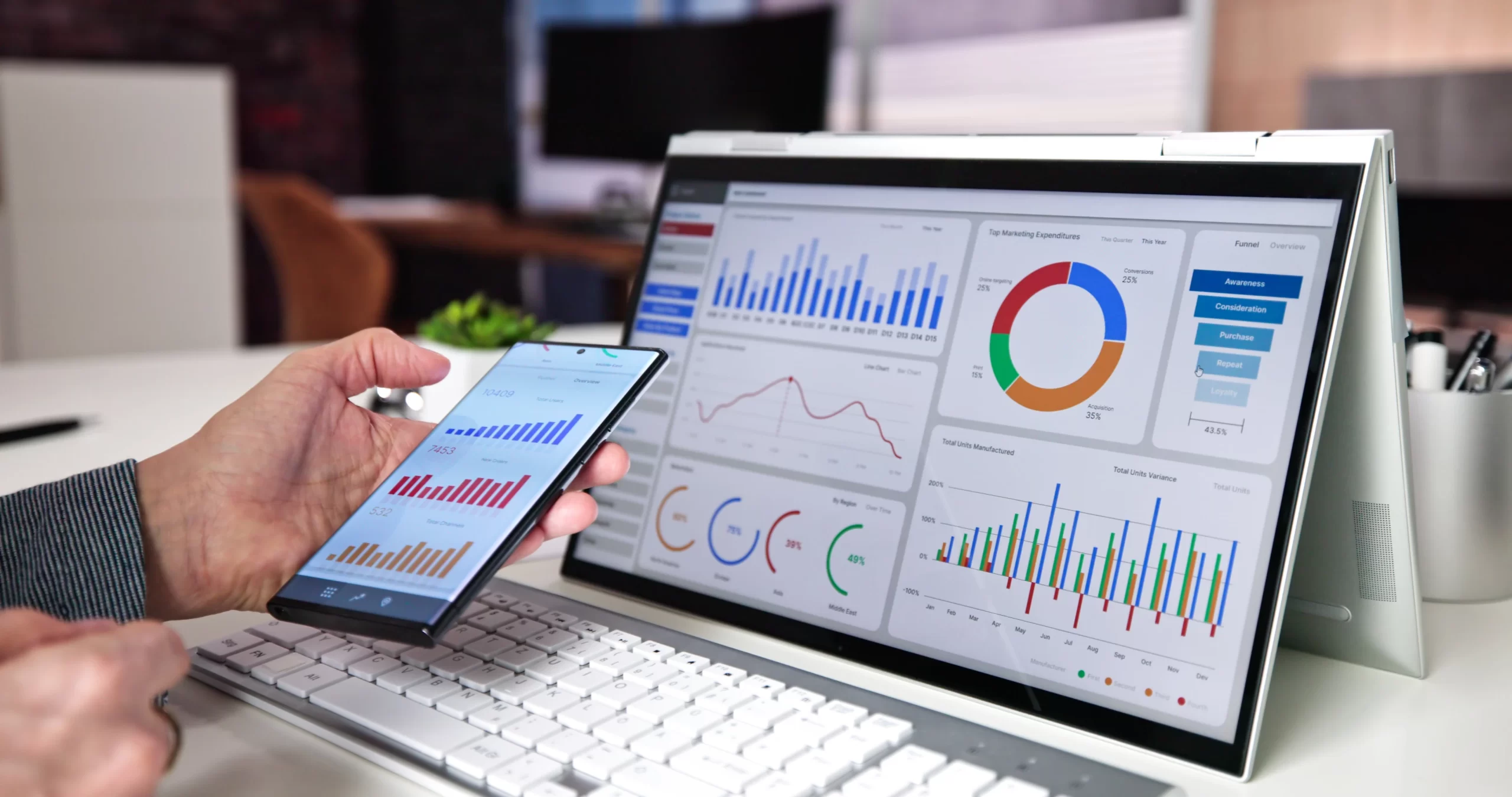
In an age of advanced people analytics, waiting weeks for HR reports just doesn’t cut it. Business moves fast in 2025, and HR leaders are under pressure to make agile, data-driven decisions in real time. Having up-to-the-minute visibility into performance trends – who’s excelling, who’s struggling, which goals are on track, and how reviews are progressing – is no longer a nice-to-have, it’s a must-have. This blog will explore why real-time performance data is so critical now, the pain points of sticking with traditional tracking methods like spreadsheets, and how modern tools (like SuiteVal) provide instant insights through live dashboards. We’ll also look at examples of how HR professionals can leverage real-time data for promotions, training, and strategy, all culminating in how SuiteVal’s solution turns raw performance data into immediate, actionable intelligence.
Whether you’re an HR manager needing quick answers for the C-suite or a people leader striving for a more responsive performance management process, read on to see how real-time performance insights can transform your HR decision-making. (And don’t miss the free demo offer at the end to experience SuiteVal’s real-time dashboards for yourself.)
HR in 2025: Why Real-Time Performance Data Matters More Than Ever
Today’s HR leaders need information now, not weeks from now. The workforce and business environment are more fast-paced and data-driven than at any time before. Key decisions about talent can’t wait for end-of-quarter reports. Here’s why real-time performance insights have become crucial in 2025:
- Business Agility: Strategies pivot quickly, and so do talent needs. If a project’s priorities change or a new market opportunity arises, leaders might need to reshuffle teams or elevate high performers on the fly. Having up-to-date performance data ensures those decisions are grounded in facts, not outdated impressions.
- Continuous Feedback Culture: Traditional annual performance reviews are rapidly being replaced by continuous feedback and ongoing check-ins. In fact, the old annual review model is in decline – 82% of companies used annual reviews in 2016, but only 54% did by 2019[1]. This shift means performance data is collected more frequently, and HR needs a way to continuously analyze it. Real-time dashboards align perfectly with a continuous feedback culture.
- Expectation of Instant Insights: Modern HR tech and people analytics have raised expectations. HR and business leaders are used to real-time metrics in areas like sales or web analytics; they now expect the same instant insight into workforce performance. Decisions about promotions, interventions, or rewards often cannot wait for weeks of number-crunching.
- Competitive Advantage: Using data faster can be a competitive differentiator in talent management. If your company can identify a struggling employee today and coach them promptly, or spot a star performer and fast-track their promotion before they get poached, you maintain an edge. A delay in recognizing these trends could mean lost talent or drops in productivity.
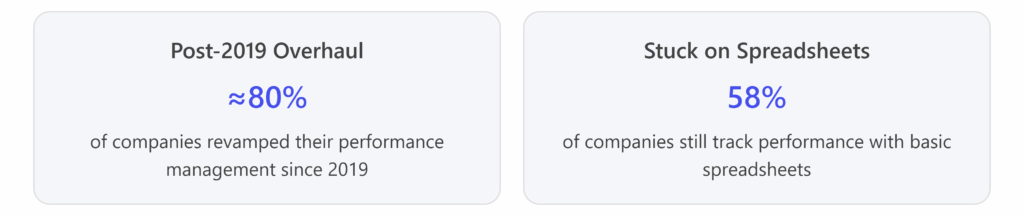
Critically, the industry has recognized this need. A vast majority of companies (around 80%) have redesigned their performance management processes since 2019 to be more agile and data-driven[1]. HR organizations know they must evolve to continuous, real-time insight models to support the business. However, there’s still a stark gap between aspiration and reality, which brings us to the pain points of traditional methods.
The Pain Points of Traditional Performance Tracking (and Why It’s Broken)
Many companies today are stuck in the past when it comes to tracking employee performance. If you’re relying on spreadsheets or annual review print-outs, you’re feeling some of these pain points:
- Data Is Siloed and Outdated: Performance information often lives in separate spreadsheets, emails, or systems that don’t talk to each other. This siloed data is usually aggregated only after a review cycle ends. The result? By the time you compile a report, the information is historical. It’s hard to act on last quarter’s data when you really need to know what’s happening right now. According to industry research, 58% of companies are still using basic spreadsheets to track and monitor employee performance[2] – meaning more than half of organizations are stuck piecing together data manually. This not only slows down insight, it risks data being incomplete or inconsistent.
- Slow, Labor-Intensive Reporting: How many hours have you spent copying and pasting data or building pivot tables for a “simple” performance report? You’re not alone. Managers spend a staggering amount of time on traditional appraisals – roughly 210 hours per year preparing annual performance reviews for their teams[2]. That’s five weeks’ worth of work hours! When HR needs a specific statistic (say, the percentage of employees meeting their goals) it often involves emailing multiple managers, waiting for replies, consolidating spreadsheets, and double-checking everything. It’s an ordeal that can take days or weeks. In fact, one survey found it takes managers on average 1–2 weeks to complete the performance review process for a single employee[2]. By the time the data is ready, decisions have been delayed and opportunities to intervene early might be missed.
- Lack of Real-Time Visibility: Because traditional tools are backward-looking, HR leaders lack real-time visibility into performance trends. For example, you might suspect that a certain team is falling behind on their targets, but until the end-of-month reports come in, you can’t be sure. This delay means small issues can turn into big problems. It also means positive achievements (like an employee exceeding goals) might go unrecognized for too long. A recent report highlighted that 40% of managers do not have access to the information they need to properly analyze employee engagement and motivation when relying on basic tools[2]. In other words, critical insights are out of reach when they’re needed most.
- Reactive Decision-Making: Because data comes late, actions are more reactive than proactive. For instance, if an annual report reveals that a certain department had a poor year, the reaction (be it training or leadership changes) happens only after the fact. Without timely data, HR misses the chance to course-correct in the middle of that year. This retrospective approach is a pain point frequently discussed on HR forums: leaders are frustrated that they’re always looking in the rearview mirror. As one example of consequences, 95% of managers say they’re unhappy with traditional performance review systems and feel they don’t accurately reflect employee contributions[1]. A big reason for that dissatisfaction is the lateness and infrequency of the insights.
The bottom line is that traditional performance tracking – annual reviews, static reports, scattered spreadsheets – leaves HR one step behind. In 2025’s environment, that’s simply not good enough. When over half of companies using spreadsheets for performance data in 2023 also show data being retrospective and fragmented[1], it’s clear why so many HR teams are eager for a better way. Next, we’ll look at how the best organizations are turning things around by embracing real-time, continuous performance management, and the tangible benefits that come with it.
From Annual Reviews to Always-On Analytics: The Shift in Performance Management
The frustration with old-school performance management has led to a significant shift in recent years. Organizations are transitioning from infrequent, rigid reviews to a more fluid, data-driven approach – essentially, from annual reviews to always-on analytics. A few trends highlight this transformation:
- Continuous Feedback is the New Norm: Rather than one major review per year, many companies have instituted quarterly goals, monthly check-ins, or even weekly one-on-ones. This generates a constant stream of performance data (feedback scores, goal progress, competency ratings, etc.). To make use of this wealth of data, HR needs tools that update and analyze information continuously. It’s no surprise that companies making this shift are seeing results – those that adopted continuous feedback have seen 40% higher employee engagement and 26% better performance on average[1][1]. But to realize these gains, that feedback can’t just sit in a file; it must be aggregated and accessible in real time.
- Agile, Data-Driven Processes: Agility in performance management means being able to adjust goals, ratings, or development plans on the fly as business needs change. Many organizations have redesigned their performance management processes in the last few years to make them more agile and data-centric – recall that about 80% of companies revamped their approach since 2019[1]. A lot of these redesigns involve implementing new software platforms that can capture ongoing performance metrics. In fact, the market for performance management software is booming, projected to grow from $5.9 billion in 2023 to $15.8 billion by 2032[1]. This growth underscores how urgently companies are investing in technology for real-time insights.
- Integrating People Analytics: Modern performance platforms often integrate with broader HR analytics (engagement surveys, turnover data, etc.), creating a more holistic picture. Real-time performance data becomes one layer in a larger people analytics dashboard. For HR decision makers, this integration means you can correlate performance with other metrics on the fly – for example, overlaying performance scores with attrition data to predict flight risks. The goal is turning all that dispersed HR information into easily accessible, actionable insights. Instead of combing through multiple reports, one live analytics system surfaces what you need.
- Cultural Change and Expectation: Perhaps one of the biggest drivers is a cultural change: employees and managers alike now expect a more engaging, tech-enabled performance experience. Millennials and Gen Z workers, especially, are accustomed to instant feedback. (In one study, 80% of office workers said they would prefer immediate feedback rather than having to wait for formal reviews[2].) This expectation pressures organizations to provide tools that allow managers to give and act on feedback in real time. The days of “no news is good news” for six months and then a surprise review are over. Companies that don’t adapt risk lower engagement – and even higher turnover – because their talent craves more timely input and development.
In summary, the trend is clear: performance management is becoming a continuous, data-driven practice, not a periodic administrative task. But making that shift successful requires technology that can keep up. Continuous feedback produces continuous data; real-time analytics is how you harness that data. Next, let’s delve into what benefits real-time performance dashboards and instant analytics actually bring to HR teams and leaders who embrace them.
Benefits of Real-Time Performance Dashboards for HR Leaders
Embracing real-time performance insights isn’t just about getting data faster for the sake of it – it’s about enabling better outcomes for the organization and its people. Here are some of the key benefits and use cases of having live performance dashboards and instant analytics at your fingertips:
- Spot Trends and Issues Early: With a real-time dashboard, HR can see patterns as they emerge, not months later. For example, if sales team productivity metrics start dipping in the last two weeks, an HR business partner can catch that and alert sales leadership to investigate or provide support before the end-of-quarter slump. Similarly, if you notice an entire team consistently missing their OKRs (Objectives and Key Results) halfway through the cycle, you can intervene with coaching or adjustments now, rather than finding out in a year-end review. Early detection of both positive and negative trends means you can respond in an agile way – preventing small problems from becoming big ones and amplifying small wins into major successes.
- Informed Promotion and Talent Decisions: Deciding whom to promote or assign to a high-stakes project shouldn’t be a shot in the dark or based on outdated info. Real-time performance data provides an accurate, up-to-date picture of each employee’s contributions and improvements. For instance, if an employee has been knocking it out of the park in the last quarter, you’ll see their performance scores and goal completion rates reflected immediately. Conversely, if someone’s performance has tailed off in the past month, that’s critical to know before making a promotion decision. When it’s time for succession planning or end-of-year calibration meetings, having a live dashboard of all employees’ ratings, feedback, and achievements can make the process far more objective and fair. You’re basing decisions on the latest evidence, not old reports or memory.
- Data-Driven Training and Development: Real-time insights help pinpoint skill gaps or coaching needs across the workforce. For example, imagine your dashboard shows that across the company, scores in “Project Management” competencies are trending lower this quarter. That could signal a need for a training program. Or perhaps you can drill down by department and see one team’s customer satisfaction scores lagging behind – maybe they need a refresher or extra support. With instant analytics, HR can slice the data by department, role, location, etc., to identify where to invest in development right now. This ensures training resources are allocated based on evidence, and employees get help in the areas they currently need it most. It’s a proactive approach to talent development that keeps pace with the business.
- Real-Time Recognition and Engagement: Performance dashboards don’t just call out problems – they also highlight successes worth celebrating. Having live data means managers and HR can recognize achievements in the moment, which is great for employee morale and engagement. For example, if an entire team just exceeded their quarterly goal ahead of schedule, a real-time report will show that immediately. HR can prompt a shout-out in the next all-hands meeting or trigger a quick reward while the accomplishment is fresh. This immediacy in recognition reinforces a high-performance culture. It’s well known that timely feedback boosts engagement – employees who get meaningful feedback weekly are far more engaged than those who only hear about performance once a year[1]. Real-time tools make weekly (or even daily) feedback feasible.
- Better Board and Executive Reporting: When it’s time to present to the board or the executive team about talent and organizational health, real-time data gives HR leaders unparalleled confidence. Instead of saying “I’ll get back to you with those numbers,” HR can answer questions on the spot: “How many of our employees are exceeding expectations right now? Let’s pull it up… it’s 18% as of this week, an increase from 15% last quarter.” Live dashboards can generate these high-level metrics instantly, complete with visual charts. This not only saves prep time for HR (no more all-nighters preparing slides with frozen data), but it also builds credibility with leadership. You’re seen as a true strategic partner who knows the pulse of the organization at any given moment. Moreover, you can run different scenarios or drill-downs live in the meeting if asked (e.g., “How is our R\&D department performing compared to Sales?”). It turns boardroom Q\&A into an opportunity to showcase HR’s command of data.
- Efficiency and Focus for HR Teams: Last but not least, when reports that used to take days can be generated in seconds, HR personnel get hours back in their week. That time can be reallocated to more strategic work – designing talent programs, improving employee experience, or working directly with managers and employees. Real-time performance management tools automate the number-crunching and data visualization. No more exporting to Excel, cleaning data, and worrying about version control – the system handles it. HR professionals can trust that everyone from line managers to the CEO is looking at the same up-to-date numbers in SuiteVal’s dashboard, for example. This means fewer ad-hoc data requests to HR and less chance of mistakes. Ultimately, it reduces the administrative burden and stress on HR teams, so they can focus on driving performance instead of just reporting on it.
In essence, real-time performance dashboards empower HR to move from reactive administrators to proactive strategists. You get to focus on what the data means and what to do about it, rather than spending all your time gathering the data.
Now, let’s zoom in on how SuiteVal specifically delivers these real-time insights and addresses the pain points we discussed, turning the vision of agile, data-driven HR into reality.
SuiteVal: Instant Analytics and Live Dashboards at Your Fingertips
Modern problems require modern solutions. SuiteVal is a cutting-edge performance management tool that was built with these very challenges in mind. It transforms the way HR teams and managers handle performance data by making it real-time, visual, and incredibly easy to use. Here’s how SuiteVal addresses the needs we’ve talked about:
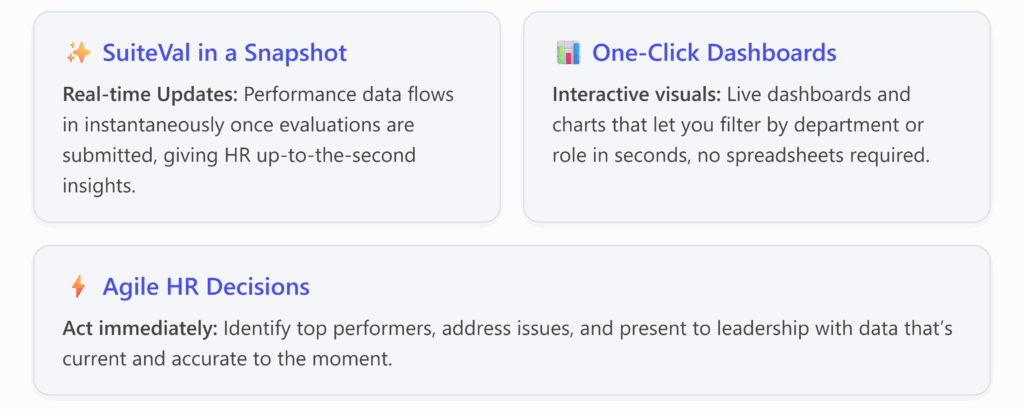
- Real-Time Reporting, No Extra Effort: With SuiteVal, the moment a manager submits an evaluation or a 360° feedback is completed, those data points flow straight into your reports. There’s no “refresh” button needed – the system automatically updates. HR can generate up-to-the-minute reports with literally one click. Need to see the latest distribution of performance ratings across the company? Open SuiteVal’s analytics dashboard and it’s already there, updated to this very minute. This immediacy means no more waiting until the end of the quarter or hassling team leads for the latest numbers.
- Live Dashboards for At-a-Glance Insights: SuiteVal’s real-time dashboard isn’t just a static chart – it’s an interactive, live view of your performance metrics. The design is visual and user-friendly, so you can spot trends at a glance. For example, a heatmap might show performance scores by department, instantly highlighting if any department is mostly “red” (below expectations) or “green” (exceeding). If you notice something interesting, you can drill down with a few clicks. Want to see a particular department’s results? Just filter the dashboard, and in seconds you’re looking only at that team’s data. The same goes for various breakdowns – by region, by job level, by performance competency, you name it. SuiteVal makes slicing and dicing the data intuitive, which means decision-makers can self-serve the insights they need on the fly.
- Instant Analytics = Agile Decisions: Because everything is updated in real time, SuiteVal enables truly agile HR decisions. Imagine it’s mid-cycle and you’re reviewing progress: in SuiteVal you notice an entire team in the Marketing department is consistently exceeding their goals (their KPI dashboard is all above 100% to goal). That’s a valuable insight – perhaps those employees deserve interim recognition, or maybe their practices should be shared with other teams. Conversely, if another team’s metrics are trending down, you can catch it early and meet with that manager to adjust course. These are the kinds of swift actions SuiteVal empowers. It essentially turns raw performance data into an ongoing narrative of what’s happening in your talent pool, so you can respond immediately and confidently.
- Eliminate Spreadsheet Drudgery: SuiteVal was specifically designed to free HR from the tyranny of Excel. There’s no more exporting data just to create a pivot table of ratings or a graph of score distributions. SuiteVal’s analytics can produce those in a snap, and they’re always current. For example, if HR wants to report the company-wide completion rate of performance reviews two weeks into the cycle, SuiteVal can show “X out of Y reviews submitted, Z% complete” in real time, broken down by department if needed. This level of automation saves countless hours and also reduces errors (no more copy-paste mishaps or version confusion). HR professionals who’ve adopted SuiteVal often cite how much smoother their performance review cycles run now – instead of chasing data, they focus on coaching managers through the process and analyzing outcomes.
- Visual, Presentation-Ready Reports: The tool comes with built-in report templates that are presentation-ready. Graphs, pie charts, bar charts, trend lines – all beautifully rendered from your live data. So if the CHRO needs a report for the board meeting, it’s essentially ready to go in SuiteVal. You can download it or even live-demo the dashboard during the meeting. SuiteVal’s reports are not only immediate but also easy on the eyes, making it simpler to communicate results to non-HR stakeholders. After all, data is only useful if people can understand it. By making the insights visual, SuiteVal helps ensure that patterns (like a spike in top-tier performance ratings or a dip in a certain competency across the company) stand out clearly for everyone to see. This ease of understanding accelerates buy-in for any actions that need to follow.
- Secure and Scalable: (It’s worth noting, especially for decision-makers concerned with IT and security, that SuiteVal’s real-time capabilities come with enterprise-grade security and privacy controls. Data is consolidated in one secure platform, which is actually safer than having dozens of performance spreadsheets flying around via email. Plus, SuiteVal scales with your organization – whether you have 50 employees or 50,000, the real-time engine works just as fast.)
All these features boil down to one thing: SuiteVal turns performance management data into immediate, actionable intelligence. It’s the difference between driving a car with GPS versus a printed map from last month – one lets you navigate current conditions, the other leaves you guessing. With SuiteVal, HR leaders and managers can navigate talent decisions with the latest information on hand.
Example in action: One SuiteVal client, a mid-size tech company’s HR Director, described their experience: “During our mid-year talent review, our CEO asked how many employees are on track to exceed their goals this year. I was able to pull up SuiteVal and answer him in seconds with a live dashboard – something I could never do before. He was impressed to see real-time stats, and we even drilled down to see which departments had the highest percentage of star performers. It sparked a great conversation about what those teams were doing right. The best part? I didn’t have to scramble for days prepping that data – SuiteVal had already done the work.” This kind of agility simply wasn’t possible when relying on spreadsheets and manual reports.
Conclusion: Turn Data Delays into Instant Insights (And Act Now)
In today’s fast-moving business climate, timely performance metrics are gold. HR professionals and executives can no longer afford to base decisions on stale data or wait around for reports to be compiled. Real-time performance insights mean the difference between reacting after the fact and responding proactively. By shedding the old spreadsheet-based habits and embracing live dashboards and instant analytics, organizations stand to gain more engaged employees, more effective managers, and better overall results.
SuiteVal is at the forefront of this real-time performance management revolution. It addresses the very pain points that hold HR teams back – consolidating siloed data, eliminating delays, and presenting insights in a way that’s easy to understand and act on. The end result? HR and business leaders can make confident, agile decisions supported by evidence whenever they need it.
Don’t let outdated processes slow down your HR strategy. It’s time to experience how real-time data can elevate your performance management.
Ready to see it in action? # and discover how immediate insights can empower your HR team to act swiftly and decisively. Make the switch to data at your fingertips – your organization and your people will thank you for it.
Real-Time HR Insights with SuiteVal
Make agile, confident decisions with live performance dashboards.
- ✔ Spot trends early
- ✔ Recognize achievements instantly
- ✔ Drive smarter promotions and training
Stop waiting. Start acting.
Ready to transform your HR strategy?
BOOK YOUR FREE SUITEVAL DEMO NOW
References
[1] Performance Management Statistics: What 2025 Holds for HR Leaders
[2] 85 Must-Know Performance Management Statistics for HR in 2025